

Automatic Settlement Profiler (ASP)
Distributed settlement measurements along a nominally horizontal profile. hydrostatic principle
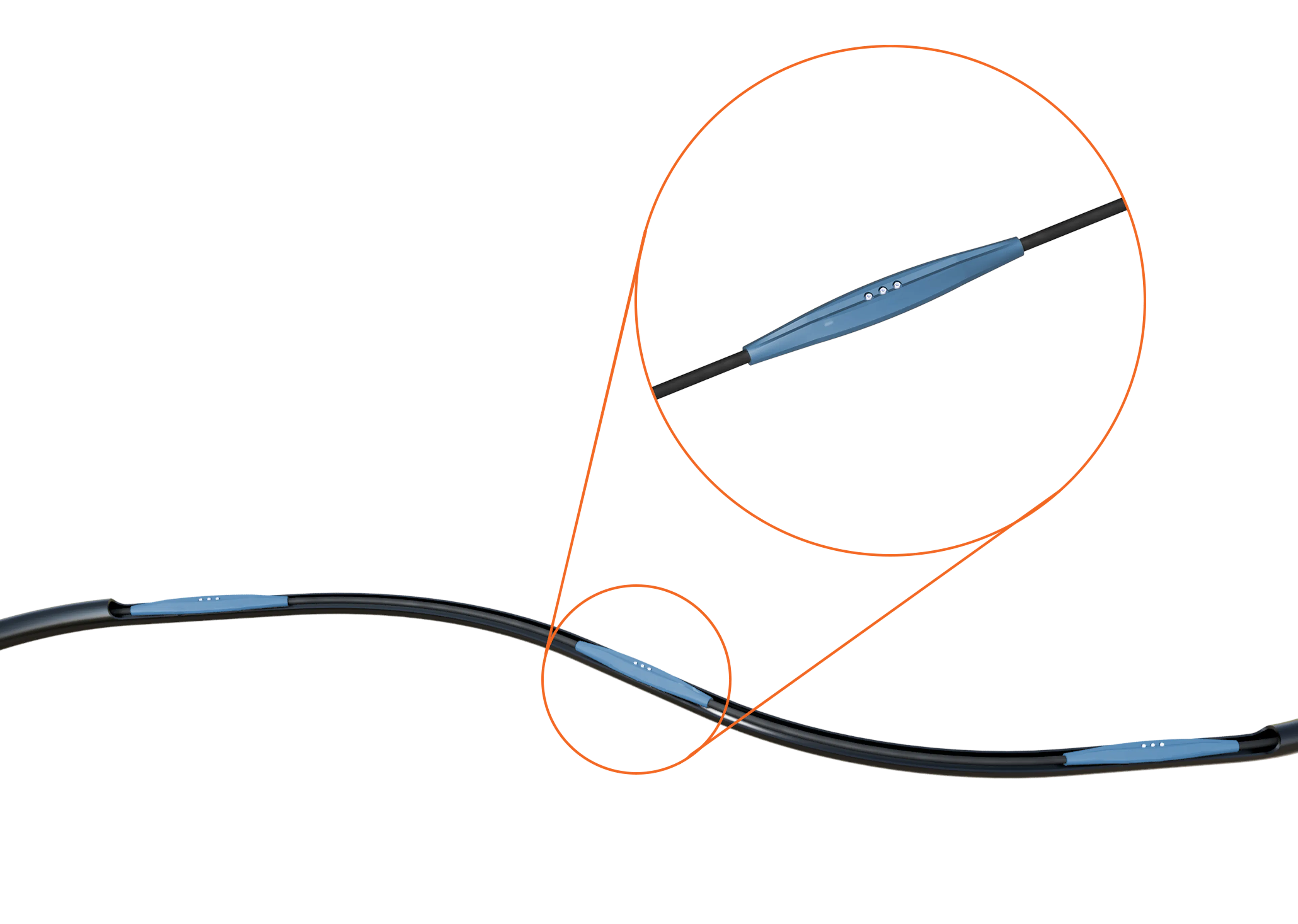
Overview
The Automatic Settlement Profiler (ASP) provides distributed settlement measurements along a nominally horizontal profile. It comprises a fluid filled MDPE hose containing pressure sensors at set intervals. Stainless steel end caps retain the fluid and a high-pressure cable gland provides cable entry for communication with the sensors.
How It Works
The ASP operates on the hydrostatic principle that pressure within a continuous body of fluid at rest will increase proportional to depth. By creating a continuous body of fluid of a known density, a series of pressure sensing nodes within the system can precisely report their elevation with respect to other sensors within the system.
The principle relies on knowledge of the density of the fluid to convert pressure to elevation. As density changes with temperature, the nodes are equipped with temperature sensors to allow on-board calibration and conversion of pressure to millimeters.
The elevation measurements reported by the sensors are relative only and do not in and of themselves provide any meaningful information. A sensor (or sensors) at a known or knowable elevation is used as a reference for all other sensors, the difference in reading indicating the variance in elevation from the reference sensor to the measurement sensor.
Key Features
-
Distributed Sensing: High precision settlement monitoring at user defined spacing
-
Temperature Compensation: On-board temperature sensors for accurate conversion
-
Pre-filled System: Arrives fully filled, de-aired and sealed
-
Robust Construction: MDPE hose with stainless steel end caps
-
Easy Installation: Can be directly buried or installed within a conduit
-
RS485 Communication: MODBUS RTU and ASCII protocols supported
Applications
The Automatic Settlement Profiler is optimized for use in bulk earthworks projects, buried within a trench beneath embankments. They are also well suited to structural applications where exposure to temperature differentials can be minimized, such as basements, tunnels or foundations.
Applications include:
-
Embankments
-
Stockpiles
-
Tunnel subsidence from surface
-
Slope/Cutting Stability
-
Bridges
-
Basements
Limitations
It is important that temperature variation across the system is kept to a minimum as the pressure on each node is affected by the entire column of fluid above it, not just the fluid proximate to the sensor. Temperature variation across the system will result in reduced system performance.
Visit the User Guides section to learn how to properly plan, install, and monitor your ASP system.